
Volkswagen Crafter — service and repair in Espoo
Volkswagen Crafter is a large commercial vehicle for transporting goods, passengers and specialised equipment. The model is used as a van, delivery vehicle, minibus, camper, construction transport and as a base for various professional conversions.
The Crafter is designed for a significantly higher load than the Caddy or Transporter. Modern versions are available with front-wheel, rear-wheel and 4MOTION all-wheel drive, and with a manual or automatic gearbox. Depending on the configuration, cargo volume of the modern Crafter is roughly 9.3 to 18.4 m³, and payload of some versions exceeds two tonnes.
In Finland the Crafter is often used professionally, so the vehicle may have high annual mileage, work under load for long periods and regularly carry heavy cargo. In such conditions timely maintenance is especially important.
At Volkkarihuolto Espoo we carry out diagnostics, scheduled maintenance and repair of Volkswagen Crafter at Ruukinmestarintie 7, 02330 Espoo.

History of the Volkswagen Crafter
The Volkswagen Crafter appeared as Volkswagen’s large commercial vehicle in the mid-2000s and became the successor to the Volkswagen LT.
The first generation was developed jointly with Mercedes-Benz and was technically related to the Mercedes-Benz Sprinter of the same period. These vehicles were produced with different body lengths, heights, payloads and powertrains.
The second-generation Crafter became Volkswagen Commercial Vehicles’ own development. This generation forms the basis of the current model.
Unlike the first Crafter, the modern vehicle gained a much wider choice of layouts. Today the Crafter can measure from about 5.99 to 7.39 metres depending on the version. In the current range the following are available:
- front-wheel drive
- rear-wheel drive
- 4MOTION all-wheel drive
- manual gearbox
- automatic gearbox
- different wheelbases
- several roof heights
Second-generation Volkswagen Crafter
The modern Crafter was developed by Volkswagen primarily as a professional commercial vehicle.
The front-wheel-drive version allows a lower cargo floor. Rear-wheel drive suits high payloads and certain specialised configurations, while 4MOTION is especially useful for winter use and difficult roads.
Volkswagen offers medium, long and maximum-length wheelbases. For the current van, cargo volume of up to 18.4 m³ is stated.
For repair work it is important to know the exact configuration of the specific vehicle, because the engine, drive layout, suspension and transmission can differ substantially.
Volkswagen Crafter service in Espoo
The Crafter often works far more intensively than a normal passenger car. A commercial vehicle may cover hundreds of kilometres a day, carry tools or materials, run at full load, tow a trailer, idle for long periods, make many short trips and start frequently in winter.
Therefore when choosing a service interval it is worth considering not only mileage but also operating conditions. For a working Crafter preventive maintenance is especially important: a breakdown often means not only repair cost but also business downtime.
It is regularly necessary to check:
- engine oil
- oil, air and fuel filters
- timing belt
- cooling system
- turbocharger
- DPF
- EGR
- AdBlue
- gearbox
- all-wheel drive
- brakes
- suspension
- tyres
- battery and alternator
- scheduled maintenance
- oil and filter change
- computer diagnostics
- annual service
Volkswagen Crafter 2.0 TDI engine
On modern Crafters the main engine is the 2.0 TDI diesel in various power outputs. It is designed for high mileage and provides the high torque a heavy commercial vehicle needs.
With proper servicing such an engine can cover substantial distances, but on a commercial vehicle it is essential to monitor engine oil, the cooling system, the turbocharger and the exhaust aftertreatment system carefully.
On a vehicle used daily for work it is not wise to keep driving even with a minor fault. A problem in one component can gradually damage other systems. Diagnostics are needed if:
- the Crafter has lost power
- Check Engine is on
- the engine has entered limp mode
- there is smoke
- fuel consumption has risen
- the vehicle starts poorly
- the engine runs unevenly
- an unusual whistling sound is heard
- oil consumption has appeared
- coolant level is dropping
- TDI diesel engine repair
- computer diagnostics
Volkswagen Crafter timing belt
Modern diesel Crafters use a timing-belt drive that must be serviced according to the schedule for the specific engine. Do not use one universal interval for all Crafters.
The exact timing depends on the engine, model year, VIN, operating conditions and previous servicing. If the vehicle history is unknown, information about the last timing-belt replacement is one of the first things to clarify after purchase.
When replacing it, the full set should be checked:
- belt
- tensioner
- idler pulleys
- water pump, if required by the design
- accessory drive belt
- timing belt replacement
Volkswagen Crafter turbocharger
The turbocharger of a commercial vehicle works under significant load. Especially high load occurs when driving with heavy cargo, a trailer or on long motorway journeys.
A boost-pressure fault does not automatically mean the turbo needs replacing. Causes may include a leaking hose, intercooler, actuator, pressure sensor, vacuum system, EGR or wiring. Diagnostics should therefore precede replacement of an expensive turbocharger.
Signs of a possible fault:
- loss of pull
- limp mode
- whistling
- smoke
- oil consumption
- boost-pressure errors
- engine diagnostics
- TDI diesel engine repair
Volkswagen Crafter DPF
The diesel particulate filter (DPF) is especially important on a modern diesel Crafter. On a vehicle that regularly drives on the highway, regeneration conditions are usually good enough. Another scenario is typical of city deliveries: the Crafter may make dozens of short trips a day, and DPF regeneration does not always have time to complete.
Before replacing the DPF you need to check actual soot load, ash amount, differential pressure, temperature sensors, EGR and injector operation. If excessive soot is caused by an engine fault, simply cleaning the filter will not be enough.
Possible symptoms:
- regeneration starts too often
- idle speed remains elevated
- fans keep running after shutdown
- fuel consumption has increased
- DPF warning appears
- the engine has lost power
- the vehicle has entered limp mode
- DPF diagnostics
Volkswagen Crafter EGR
EGR is used to reduce nitrogen oxide emissions. Exhaust gas passes through the system, so soot and deposits can accumulate over time.
Not only the EGR valve itself may need checking, but also the cooler, sensors and control components. If coolant level gradually drops alongside an EGR fault, the cooling system and EGR cooler should be inspected especially carefully.
Possible symptoms:
- Check Engine
- loss of power
- jerking
- uneven running
- limp mode
- frequent DPF regenerations
- EGR diagnostics
Volkswagen Crafter AdBlue and SCR
Modern Crafters use an SCR system and AdBlue to reduce nitrogen oxide emissions. An AdBlue fault does not always mean a low fluid level.
It is especially important to respond promptly to a message with a countdown to engine start inhibition. If the system reports that starting will become impossible after a certain number of kilometres, diagnostics should be carried out immediately.
A fault may be related to:
- NOx sensor
- AdBlue pump
- injector
- heater
- level sensor
- wiring
- control unit
- AdBlue diagnostics
Volkswagen Crafter automatic gearbox
The modern Crafter can be fitted with an automatic gearbox. An automatic is especially convenient for an urban commercial vehicle that constantly starts and stops.
When operating under heavy load, transmission condition is particularly important. Diagnostics must take into account not only the gearbox but also the engine, mounts, driveshafts and electronic control.
Inspection is needed if:
- engaging D or R is delayed
- shocks appear
- shifts have become noticeably harsher
- the gearbox slips
- vibration occurs
- a transmission fault appears
- the vehicle enters limp mode
- transmission oil change
Manual gearbox, clutch and flywheel
A manual gearbox is widely used on the Crafter. In commercial use the clutch can take a serious load, especially if the vehicle regularly carries heavy cargo, tows, works in the city or pulls away on hills.
On a diesel it is also necessary to assess the dual-mass flywheel. Signs of wear:
- the clutch slips
- the biting point has changed
- the vehicle vibrates when pulling away
- a metallic knock is heard
- gears engage with effort
- noise appears when using the clutch
- manual gearbox diagnostics
Volkswagen Crafter 4MOTION
The modern Crafter is available with 4MOTION all-wheel drive. Volkswagen’s current range includes front-wheel, rear-wheel and all-wheel-drive versions.
For Finland, 4MOTION can be useful on snowy roads, construction sites and poorly surfaced access roads. But all-wheel drive also means additional components that need diagnosing and servicing.
Tyres must also be monitored. A large difference in size or wear between wheels can place extra load on the drivetrain. It is worth coming to the workshop if:
- the vehicle struggles to pull away on a slippery surface
- an all-wheel-drive fault appears
- a humming noise appears
- vibration occurs
- torque transfer feels unstable
Crafter front- and rear-wheel drive
One feature of the modern Crafter is the choice of drive type. Because of different layouts, even usable cargo volume can differ. Volkswagen states that rear-wheel and all-wheel-drive versions have a floor about 100 mm higher than the front-wheel-drive configuration.
For suspension and transmission repair it is essential to take the specific drive version into account.
- Front-wheel drive — allows a lower cargo floor and can be more convenient for city delivery
- Rear-wheel drive — suits vehicles that regularly carry a heavy load
- 4MOTION — adds traction on slippery surfaces
Volkswagen Crafter suspension
Crafter suspension is designed for professional use, but it constantly works under significant load. Wear can appear especially quickly on vehicles that regularly run at maximum mass.
On a loaded van a suspension fault affects not only comfort but also handling. The following need checking:
- shock absorbers
- springs
- bushes
- silent blocks
- ball joints
- track-rod ends
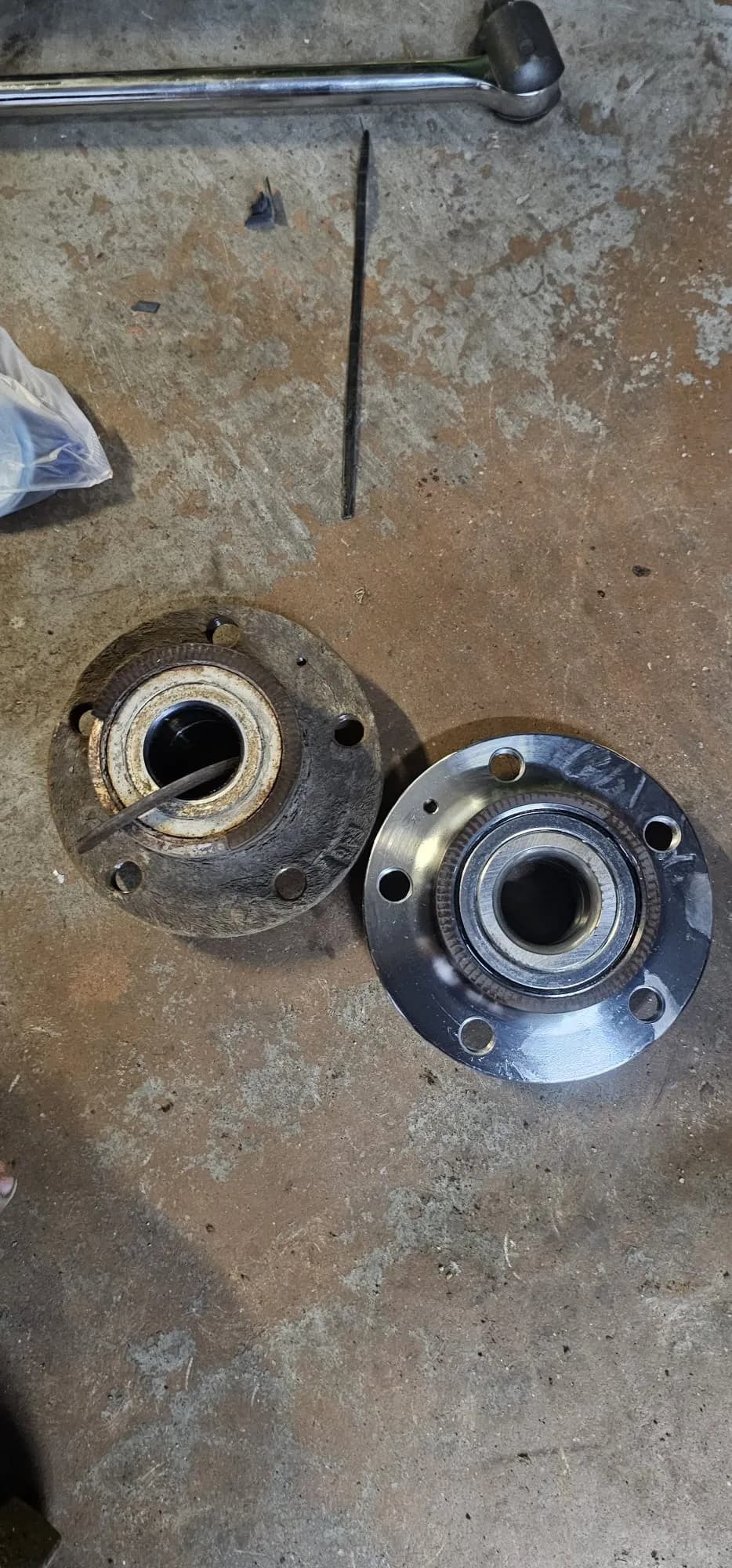
- wheel bearings
Volkswagen Crafter wheel bearings
The vehicle’s large mass places high load on the wheel bearings. A typical sign of wear is a hum that increases with speed.
However, a similar sound can come from commercial tyres, uneven tread wear, the final drive or transmission. Before replacing a bearing the exact noise source must be identified.
Volkswagen Crafter braking system
Crafter brakes are designed for a heavy vehicle, but their actual load depends strongly on the cargo. A modern Crafter can have a payload from a few hundred kilograms to more than 2.5 tonnes in some configurations.
In Finland, road salt also accelerates corrosion of discs, calipers and brake lines. Inspection is needed if:
- vibration appears
- a metallic sound is heard
- the vehicle pulls to one side
- one wheel gets very hot
- braking distance has increased
- the parking brake does not work correctly
Volkswagen Crafter tyres
For a large commercial vehicle the correct tyre size and load index are especially important. It is not enough simply to fit a tyre of a suitable diameter.
Too low pressure on a loaded Crafter can lead to tyre overheating and rapid structural failure. Uneven wear can also indicate a suspension fault or incorrect geometry.
You need to consider:
- permitted mass
- pressure
- load distribution
- operating conditions
- rear-axle configuration
Volkswagen Crafter cooling system
A large diesel van can work under high load for long periods, so the cooling system is especially important. If the level has to be topped up regularly, a leak must be found. Ignoring the problem can end in engine overheating.
Causes of fluid loss may include:
- pump
- thermostat
- radiator
- hoses
- EGR cooler
- heat exchanger
- coolant leak detection
Battery and alternator
A working Crafter often has significantly more electrical load than a normal car. An auxiliary heater, refrigeration equipment, interior lighting, inverter, chargers, lifting equipment and an additional battery may also be fitted.
In winter cold starts add to this. If equipment was installed after the vehicle was purchased, it is also useful to check the quality of the additional electrical connections.
A weak battery may be indicated by:
- slow starting
- random faults
- Start-Stop problems
- unstable electronics
- electrical repair
Webasto and auxiliary heater
For a Crafter in Finland an auxiliary heater is especially useful. It can be used for pre-heating or cabin heating.
Causes may include the fuel pump, glow plug, circulation pump, weak power supply or a system lockout after several failed starts. A fault may show as follows:
- Webasto does not start
- shuts off immediately
- smokes heavily
- runs for a few minutes
- shows an error
- drains the battery quickly
Sliding and rear doors
The doors of a working Crafter may open dozens of times a day. In winter ice, salt and dirt get into the mechanisms.
If the large side door has started to sag or close with effort, it is better to adjust it early before the guides and lock are damaged. Over time the following can wear:
- rollers
- guides
- handles
- locks
- check straps
- hinges
Air conditioning and heating
A working climate system is important for a driver who may spend the whole working day in the Crafter. Simply topping up refrigerant without finding the cause will not solve the problem if the system is leaking.
If the cabin takes a long time to warm up in winter, check the thermostat and cooling system. If the air conditioning has stopped cooling, the cause may be:
- a leak
- condenser
- compressor
- pressure sensor
- fan
- air conditioning service
Electronics and driver assistance systems
The modern Crafter is fitted with significantly more electronics than older commercial vans. The current Crafter offers a digital instrument cluster and a central multimedia display of 10.3 or 12.9 inches depending on equipment.
Various driver assistance and parking systems may also be used. Before replacing an electronic unit, power supply and battery condition must be checked.
It is worth coming for diagnostics if:
- many faults appear at once
- Front Assist is unavailable
- parking sensors do not work
- the camera shows an error
- multimedia restarts
- the battery discharges quickly
- computer diagnostics
Volkswagen Crafter body and corrosion
The Crafter often works in harsh conditions, so the body takes more mechanical damage than a normal passenger car. On a van the paintwork near the cargo doors is also frequently damaged.
Finnish road salt accelerates corrosion in already damaged areas. Inspect especially carefully:
- sills
- steps
- wheel arches
- lower door edges
- underbody
- crossmembers
- suspension mounts
- rear doors
- areas of previous body repair
Different Volkswagen Crafter sizes
The Crafter has a huge number of body variants. Cargo volume can reach about 18.4 m³.
This is important even for ordinary servicing: a long Crafter Maxi with a high roof may need a lift and premises sized for the corresponding dimensions and mass.
The modern Panel Van is offered with lengths of about:
- 5,986 mm — medium wheelbase
- 6,836 mm — long
- 7,391 mm — Long Wheelbase Maxi
Volkswagen Crafter as a camper
The Crafter is often used as a camper base. Such a vehicle may have additional equipment: a second battery, auxiliary heater, inverter, solar panels, fridge, charging equipment and an extra water system.
When diagnosing electrical problems it is important to take into account everything fitted after the vehicle left the factory. Incorrectly connected additional equipment can cause current drain and rapid battery discharge.
Volkswagen Crafter pre-purchase inspection
For a used Crafter, diagnostics before purchase are especially important. The vehicle may have been used daily for several years and carried significant cargo.
It is also necessary to understand the previous type of use. A courier van with constant short trips and a construction Crafter that carried heavy materials every day develop completely different kinds of wear.
Before buying it is worth checking:
- cold start
- engine
- turbo
- DPF
- EGR
- AdBlue
- timing belt
- gearbox
- clutch and flywheel
- 4MOTION
- driveshafts
- suspension
- wheel bearings
- brakes
- tyres
- electrics
- auxiliary heater
- body
- underbody
- computer diagnostics
Volkswagen Crafter services we provide
At Volkkarihuolto Espoo you can come for:
- Crafter scheduled maintenance
- engine oil and filter change
- computer diagnostics
- 2.0 TDI servicing
- turbocharger diagnostics
- DPF diagnostics
- EGR inspection
- AdBlue diagnostics
- timing belt replacement
- automatic gearbox diagnostics
- manual transmission servicing
- clutch and flywheel replacement
- 4MOTION diagnostics
- brake system repair
- suspension diagnostics
- wheel bearing replacement
- coolant leak detection
- battery and alternator check
- auxiliary heater diagnostics
- air conditioning service
- electronics diagnostics
- inspection preparation
- Volkswagen Crafter pre-purchase inspection
Common Volkswagen Crafter fault signs
Book diagnostics if:
- Check Engine is on
- the Crafter has lost power
- the engine has entered limp mode
- a DPF fault appears
- regeneration starts too often
- an EGR fault appears
- an AdBlue fault is displayed
- a strong turbo whistle is heard
- coolant level is dropping
- the automatic shifts with shocks
- the clutch slips
- flywheel knock appears
- the vehicle vibrates under acceleration
- 4MOTION works unstably
- the suspension knocks
- a wheel-bearing hum appears
- the brakes vibrate
- Webasto does not start
- the battery discharges quickly
Volkswagen Crafter repair in Espoo
Need repair or scheduled maintenance for a Volkswagen Crafter? Contact Volkkarihuolto Espoo at Ruukinmestarintie 7, 02330 Espoo.
We can diagnose the 2.0 TDI engine, DPF, EGR, AdBlue, turbocharger, gearbox, 4MOTION, brakes, suspension, cooling system, auxiliary heater and electrical equipment.
When servicing a Volkswagen Crafter it is especially important to take into account the specific vehicle configuration: front-, rear- or all-wheel drive, body length and height, gross mass and the nature of commercial use. For a working van, timely preventive maintenance helps not only avoid major repairs but also reduce the risk of unplanned downtime.
FAQ
How does the Volkswagen Crafter differ from the Transporter?
The Crafter is significantly larger and designed for heavier commercial tasks. A modern Crafter can be up to 7.39 metres long with cargo space up to 18.4 m³, while the Transporter belongs to a more compact van class.
Which engines are fitted to the Volkswagen Crafter?
On the modern European Crafter the main engines are 2.0 TDI diesels in various power outputs. The exact version depends on the year, drive layout and gross vehicle mass.
Is there a Volkswagen Crafter with an automatic gearbox?
Yes. The modern Crafter is offered with both a manual and an automatic gearbox.
Is there a Crafter with all-wheel drive?
Yes. The current range includes 4MOTION versions alongside front- and rear-wheel drive.
Why does the Volkswagen Crafter lose power?
Possible causes include DPF, EGR, turbocharging, AdBlue/SCR, injectors, the fuel system or sensors. Diagnostics are required before repair.
Why does the Crafter start DPF regeneration often?
The cause may be constant short trips or an engine fault that produces excessive soot.
Why does the Crafter vibrate under acceleration?
It is worth checking the driveshafts, CV joints, propeller shaft on relevant versions, engine mounts, wheels and transmission.
Does 4MOTION need servicing?
Yes. The scope of servicing depends on the specific system version. Suitable tyre sizes should also be used and even wear monitored.
What cargo volume does the Volkswagen Crafter have?
Depending on wheelbase, roof height and drive type, the modern Crafter Panel Van offers roughly 9.3 to 18.4 m³ of cargo space.
Can a Volkswagen Crafter be inspected before purchase?
Yes. For a used commercial vehicle such an inspection is especially useful. We recommend checking the engine, DPF, EGR, AdBlue, transmission, suspension, brakes, electrics and body.
Detailed Services
Professional fault diagnostics for Volkswagen Crafter.
Oil ChangeEngine oil and filter replacement for Volkswagen Crafter.
Annual maintenanceComprehensive annual maintenance for Volkswagen Crafter.
Regular MaintenanceScheduled maintenance for Volkswagen Crafter according to service needs.
Engine RepairEngine diagnostics and repair for Volkswagen Crafter.
Diesel Engine RepairDiesel engine service and repair for Volkswagen Crafter.
Electrical RepairElectrical fault tracing and repair for Volkswagen Crafter.
ECU ProgrammingControl unit programming and coding for Volkswagen Crafter.
DSG RepairDSG transmission diagnostics and repair for Volkswagen Crafter.
Transmission RepairTransmission diagnostics and repair for Volkswagen Crafter.
Transmission Oil ChangeTransmission oil change for Volkswagen Crafter.
Timing Belt ReplacementTiming belt and related component replacement for Volkswagen Crafter.
Timing Chain ReplacementTiming chain, tensioner, and guide replacement for Volkswagen Crafter.
Cooling System RepairCooling system service and repair for Volkswagen Crafter.
AC RepairAir conditioning service and repair for Volkswagen Crafter.
Engine Heater InstallationEngine heater installation and service for Volkswagen Crafter.
Cabin OzonationCabin ozonation and odor removal for Volkswagen Crafter.









.webp&w=3840&q=75)
.webp&w=3840&q=75)