Audi e-tron — diagnostics and service in Espoo
Audi e-tron is the first series-production fully electric Audi SUV and one of the most important models in the brand’s electrification history. The car appeared in 2018, and after a major update the family was renamed Audi Q8 e-tron.
On the Finnish used-car market today you will find both early Audi e-tron 50 and 55 quattro models and updated Q8 e-tron cars. Despite the lack of an internal combustion engine, these are technically complex vehicles with a high-voltage battery, two or three electric motors, liquid cooling, AC/DC charging, electric quattro, air suspension and a large number of electronic control units.
At Volkkarihuolto Espoo you can book diagnostics and service for Audi e-tron at Ruukinmestarintie 7, 02330 Espoo.
Work directly on high-voltage components is carried out only with the required qualifications and in line with safety requirements.
History of the Audi e-tron
The Audi e-tron appeared in 2018 and became the first series-production fully electric Audi. The original e-tron received a large lithium-ion battery of up to 95 kWh, two electric motors and electric quattro all-wheel drive. Audi designed the car from the start for DC fast charging of up to 150 kW — a high figure for a production EV of that period.
In 2022 Audi presented a major model update and renamed the family Q8 e-tron. The updated car gained higher usable battery capacity, improved aerodynamics, a more efficient rear electric motor and higher DC charging speed on the upper versions.
Production of the Q8 e-tron at the Audi Brussels plant ended at the end of February 2025. As a result, in 2026 both the Audi e-tron and the Q8 e-tron are already used-market models.
Main first-generation variants:
- Audi e-tron 50 quattro
- Audi e-tron 55 quattro
- Audi e-tron Sportback
- Audi e-tron S
- Audi e-tron S Sportback
Audi e-tron and Q8 e-tron — what is the difference?
Technically this is the development of one model. The original car was called Audi e-tron. After the facelift — Audi Q8 e-tron. The update was still fairly extensive.
So during diagnostics it is important to consider not only the e-tron name, but also the model year and the specific version. Changes include:
- batteries
- usable capacity
- range
- electric motor efficiency
- aerodynamics
- charging speed
- chassis settings
- some electronic systems
Audi e-tron 55 quattro
The Audi e-tron 55 quattro is one of the most common versions on the used market. Early cars received a battery with a nominal capacity of 95 kWh. After a software increase of the usable window, Audi stated about 86 kWh of usable energy for the corresponding versions.
Maximum DC charging power is up to 150 kW. Audi stated that under suitable conditions charging from roughly 5 to 80% takes about 30 minutes.
AC charging is up to 11 kW as standard and up to 22 kW on appropriately equipped cars.
Audi e-tron 50 quattro
The 50 version has a smaller battery and lower power than the 55. The exact configuration can be determined from the VIN and diagnostic data.
During diagnostics it is important to identify the exact car version, because battery capacity, range, charging characteristics and software can differ.
Audi Q8 50 e-tron
After the update the base version became the Q8 50 e-tron. Audi states 95 kWh total capacity, 89 kWh usable, two electric motors, all-wheel drive, power up to 250 kW, AC up to 11 kW, optional AC up to 22 kW and DC up to 150 kW.
Claimed WLTP range reached about 491 km for the SUV and 505 km for the Sportback depending on equipment and test conditions.
Audi Q8 55 e-tron
The Q8 55 e-tron received a larger battery. Official figures: 114 kWh total capacity, 106 kWh usable capacity, two electric motors, all-wheel drive, power up to 300 kW, torque up to 664 Nm, DC charging up to 170 kW, AC up to 11 kW and optional AC up to 22 kW.
Audi claimed WLTP range of up to about 582 km for the Q8 55 e-tron and 600 km for the Q8 Sportback 55 e-tron.
Audi e-tron high-voltage battery
The high-voltage battery is one of the most expensive and important components of the car. On the original e-tron 55 the battery has a nominal capacity of 95 kWh, 36 modules, 432 lithium-ion cells and a nominal voltage of about 396 V.
The battery is located under the floor between the axles and is integrated into a robust protective housing.
Battery diagnostics typically assess:
- stored faults
- voltage of individual cell groups
- temperatures
- balancing
- cooling system condition
- charging parameters
- usable capacity
- computer diagnostics
Audi e-tron battery degradation
Any lithium-ion battery gradually loses some of its original capacity. But a shorter range does not automatically mean serious degradation.
Range is strongly affected by air temperature, speed, heating, wheel size, tyre pressure, snow, wind, driving style and how often short trips are made. In Finnish winters the real-world range can be significantly lower than in summer.
If the drop seems unusually large, it is worth assessing battery condition, actual consumption, temperature parameters, faults and the operation of heating and the heat pump.
How to check an e-tron battery before purchase?
The range figure on the instrument cluster alone is not enough. It is calculated from recent driving. If possible, the car should also be checked at different states of charge.
Before purchase it is useful to check:
- HV battery faults
- condition of individual cells
- AC charging
- DC charging
- cooling system
- warning history
- actual energy consumption
- computer diagnostics
Audi e-tron DC charging
One of the e-tron’s strong points is stable fast charging. The original e-tron 55 can accept up to 150 kW DC and sustain high power over a significant part of the charging curve.
On the updated Q8: 50 e-tron — up to 150 kW, 55 e-tron — up to 170 kW, SQ8 e-tron — up to 170 kW. Audi states about 31 minutes to charge a Q8 e-tron from 10 to 80% under optimal conditions.
If the Audi e-tron charges slowly
Low DC charging speed does not necessarily mean a fault. For example, with a cold battery charging power can be substantially limited.
If the car consistently accepts too little power even after a longer drive and at a suitable HPC station, the system should be checked. Power depends on:
- battery temperature
- state of charge
- ambient temperature
- station capability
- limits of the charging point itself
- battery condition
- thermal management
- computer diagnostics
Audi e-tron will not charge
If charging does not start at all, the cause may not be the battery. It is useful to check AC charging and DC charging separately. If AC works but DC does not, the range of possible causes becomes narrower.
It is worth checking:
- the charging station
- the cable
- the connector
- charge port locking
- the 12V battery
- charging electronics
- HV system faults
- communication between the car and the station
- computer diagnostics
- electrical system repair
Audi e-tron AC charging
The original e-tron supports AC charging up to 11 kW and, on appropriately equipped cars, up to 22 kW. The updated Q8 e-tron also has 11 kW as standard and 22 kW as an option.
If the car charges on only some phases or power is substantially below expectations, check the charging station, cable, onboard charger, power supply and vehicle faults.
Charge ports
Depending on market and equipment, an e-tron may use a charge port on one side or additional connection options. If the plug cannot be removed, do not use excessive force. First determine whether the mechanism is unlocked.
Problems may be related to:
- the flap mechanism
- cable locking
- the actuator
- sensors
- wiring
- electrical system repair
Audi e-tron 12-volt battery
Despite the large traction battery, the Audi e-tron also uses a conventional 12V system. If the 12V battery is discharged, the car may not activate the high-voltage system at all.
The 12-volt battery is required for control units, locks, high-voltage system start-up, lighting and electronic systems. That is why diagnostics of numerous electronic faults often should start with a check of the low-voltage system.
Possible signs of a weak 12V battery:
- the car does not go into Ready
- many faults appear
- central locking does not work
- the multimedia system reboots
- random warnings appear
- electrical system repair
- computer diagnostics
Audi e-tron electric motors
A regular e-tron quattro uses electric motors on the front and rear axles. Updated Q8 50 and 55 e-tron models also use one electric motor at the front and one at the rear.
An electric motor does not need the same regular service items as an internal combustion engine. There is no need to change ICE engine oil, spark plugs, a fuel filter or a timing belt.
But the electric drivetrain still includes bearings, gearboxes, seals, cooling and power electronics. Unusual humming or vibration requires diagnostics.
Audi e-tron electric quattro
Quattro on the e-tron works completely differently from the mechanical quattro of petrol and diesel Audis. The front and rear axles have their own electric motors. Torque distribution is controlled electronically.
In normal driving the system can optimise use of the electric motors for efficiency and, when needed, redistribute torque very quickly. This means there is no classic centre differential typical of many ICE Audis.
SQ8 e-tron
The most powerful version of the updated family is the SQ8 e-tron. It uses three electric motors: one at the front and two at the rear. Each rear electric motor drives its own wheel.
The system develops up to 370 kW and 973 Nm. The battery has 114 kWh total and 106 kWh usable capacity. Three electric motors allow more precise torque distribution between the rear wheels.
High-voltage battery cooling system
Battery temperature substantially affects charging power, vehicle power, battery life and efficiency. The original e-tron uses a complex liquid thermal management system.
Audi stated about 40 metres of cooling channels and roughly 22 litres of coolant in the e-tron 55 system. Coolant loss therefore must not be ignored. The source of the leak must be identified.
Audi e-tron thermal management
In an electric car, cooling serves more than one component. Temperature must be controlled for the battery, electric motors, power electronics, charging system and cabin.
If thermal management works incorrectly, possible results include power limitation, slow DC charging, HV system faults, weak heating and increased energy consumption.
Heat pump and heating
Heating in an electric car affects range directly. Depending on configuration, the e-tron uses a complex heat recovery and climate control system. In Finland it is especially important that the system works reliably in winter.
Unusually high winter energy use does not always mean a battery fault — the cause may be the climate system. A check is needed if:
- the cabin heats poorly
- heating works unstably
- consumption has risen sharply
- climate system faults appear
- windows defrost poorly
- air conditioning service
- computer diagnostics
Audi e-tron air suspension
The Audi e-tron is a heavy premium SUV, and many cars are fitted with adaptive air suspension. It allows ride height to be changed and body height to adapt automatically.
If there is a leak, replacing only the compressor may not solve the problem. A check is needed if one corner of the car is lower, the body drops overnight, the compressor runs too often, the car will not rise or a suspension fault appears.
Possible causes:
- air spring strut
- air line
- valve block
- compressor
- level sensor
- computer diagnostics
Audi e-tron suspension
The large battery mass places significant load on chassis components. The Q8 e-tron weighs about 2.5 tonnes without a driver depending on version. Official Q8 e-tron technical data specify five-link front and rear suspension.
Correct wheel alignment is especially important. Over time the following can wear:
- control arms
- bushings
- ball joints
- anti-roll bar links
- wheel bearings
- computer diagnostics
Uneven tyre wear on Audi e-tron
Electric cars deliver high torque from zero speed. Combined with high mass, this increases tyre load. For electric quattro it is important to use suitable tyres of the same size.
Fast or uneven wear may be linked to:
- suspension geometry
- pressure
- driving style
- play in joints
- incorrect tyre size
Wheel bearings
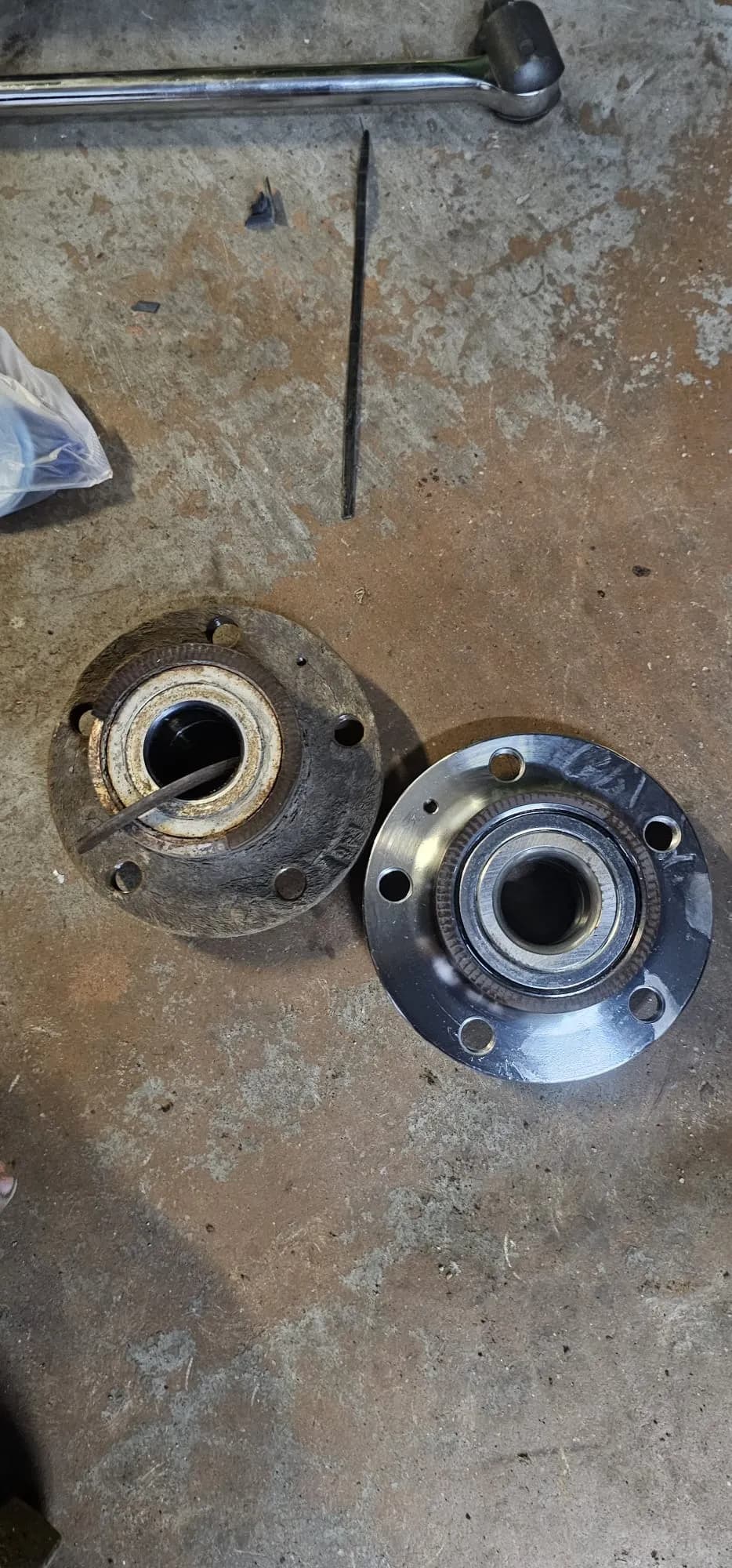
A worn wheel bearing can create a hum that increases with speed. But similar sounds can also come from tyres, a gearbox or an electric motor.
So before replacing a part, the source of the noise should be identified.
Audi e-tron braking system
An electric car uses energy recuperation when braking. Because of this, conventional friction brakes may be used less often. For Finland this creates a separate issue: brake discs can suffer more from corrosion.
Less frequent brake use does not mean they need no service. Especially after winter it is worth checking:
- discs
- pads
- calipers
- guides
- inner disc surfaces
Audi e-tron recuperation
During deceleration the electric motors can work as generators and return energy to the battery. If recuperation is temporarily limited, that does not necessarily mean a fault.
Limitation may depend on a high battery state of charge, low temperature or HV system condition. If recuperation is constantly missing and faults appear at the same time, the car should be diagnosed.
Steering
The Audi e-tron uses electromechanical power steering. After suspension repair, alignment must be carried out correctly.
A check is needed for:
- a steering fault
- unusually heavy steering
- play
- unusual noise
- uneven steering wheel position
- computer diagnostics
Battery protection and underbody
The high-voltage battery sits under the floor of the car. After a hard underbody impact it is therefore especially important to inspect the underside. If the high-voltage battery housing is damaged, the car needs a professional assessment.
For example, after hitting a stone, a high kerb, a road obstacle or an accident, inspect:
- battery protection
- housing
- mountings
- signs of deformation
- leaks
- computer diagnostics
Audi e-tron after an accident
After a serious collision, more than bodywork must be considered. Before buying a repaired e-tron it is especially important to understand the nature of the previous damage.
Checks may include:
- HV battery
- pyrotechnic disconnect
- high-voltage cables
- cooling
- electric motors
- charging system
- computer diagnostics
Audi e-tron air conditioning
The climate system in an EV plays a more important role than in a conventional car. It is linked not only to passenger comfort but also to thermal management of vehicle components.
If air conditioning or heating works incorrectly, diagnostics are needed. Do not use the wrong oil type or equipment not intended for electric cars, because the compressor is connected to the high-voltage system.
MMI and electronics
The Audi e-tron has a large number of electronic control units. Before replacing an expensive component, diagnostics are required.
Possible issues: MMI reboots, the screen does not turn on, sound disappears, the app does not show data, remote climate control does not work or many warnings appear. The cause may lie in 12V power supply, software, a control unit or communication between modules.
Cameras, radars and assistants
The Audi e-tron can be equipped with adaptive cruise control, Audi pre sense, Lane Assist, 360° cameras, blind-spot monitoring and parking assistants.
In winter, snow and ice can also temporarily block cameras and radars. After glass replacement, body repair, suspension repair or geometry changes, sensor calibration may be required.
Audi e-tron virtual mirrors
On some e-tron models, cameras with displays inside the doors were fitted instead of conventional side mirrors. Replacing the whole system without diagnostics can be unnecessarily expensive.
If the image disappears, flickers, lags or a fault appears, check the camera, wiring, power supply, display and communication between units.
Powered tailgate and doors
A large amount of electrical equipment also means more possible faults. A weak 12V battery can also cause unstable operation of these systems.
It is worth checking:
- powered tailgate
- locks
- Keyless
- charge flaps
- position sensors
- electrical system repair
Pre-purchase inspection of an Audi e-tron
Checking a used e-tron should differ from diagnostics of a conventional TFSI or TDI. There is no point checking DPF, EGR or a timing chain. It is still important to check the car’s history.
Instead, special attention is given to:
- the high-voltage battery
- HV system faults
- AC charging
- DC charging
- the 12V battery
- electric motors
- gearboxes
- the cooling system
- the climate system
- air suspension
- brakes
- tyres
- MMI
- assistants
- underbody and battery housing condition
- computer diagnostics
What to check on a test drive
After a test drive it is useful to read diagnostic data from all control units. During the drive, pay attention to:
- absence of unusual humming
- smooth pull
- absence of vibration
- recuperation operation
- heating operation
- dashboard warnings
- air suspension operation
- steering wheel position
- computer diagnostics
Winter use of Audi e-tron
A Finnish winter is a demanding operating mode for any EV. At low temperature consumption rises, available range falls, charging a cold battery can be slower and heating uses extra energy.
These are normal EV characteristics. But if energy consumption becomes abnormally high or charging remains very slow even after the car has warmed up, thermal management should be checked.
How to improve winter range
Real-world range always depends on temperature and driving conditions. It helps to:
- preheat the cabin while plugged in
- use preconditioning
- monitor tyre pressure
- avoid unnecessarily large wheels
- use seat heating instead of maximum cabin heat when that is comfortable
Q8 e-tron discontinued
Audi ended Q8 e-tron production at the Brussels plant at the end of February 2025. This matters for a used-car owner.
The end of production itself does not mean the car becomes unserviceable. But when buying, consider:
- cost of original components
- availability of individual parts
- condition of the high-voltage system
- remaining factory warranty on relevant components
- service history
Which Audi e-tron services we provide
At Volkkarihuolto Espoo you can book diagnostics and service. Work directly on the high-voltage battery and high-voltage components is carried out only with the appropriate qualifications and when the specific operation can be performed safely.
- Audi e-tron computer diagnostics
- high-voltage system fault diagnostics
- 12V battery check
- AC charging diagnostics
- DC charging diagnostics
- charge port check
- electric quattro diagnostics
- electric drivetrain check
- cooling system diagnostics
- climate system check
- brake repair
- air suspension diagnostics
- conventional suspension diagnostics
- wheel bearing replacement
- tyre and alignment check
- MMI diagnostics
- camera and electronic assistant check
- electrical system diagnostics
- underbody inspection after impact
- preparation for inspection
- pre-purchase Audi e-tron inspection
Common Audi e-tron fault signs
Book diagnostics if:
- the car does not go into Ready
- an electrical system fault appears
- the car will not charge
- AC works but DC charging does not
- charging keeps interrupting
- DC power is unusually low
- unusual drivetrain humming appears
- energy consumption has risen sharply
- heating works poorly
- coolant level is falling
- air suspension is dropping
- brakes rust or work unevenly
- many faults appear at once
- MMI reboots regularly
- a high-voltage system warning appears
Audi e-tron diagnostics and service in Espoo
Need diagnostics or service for an Audi e-tron? Contact Volkkarihuolto Espoo at Ruukinmestarintie 7, 02330 Espoo.
For an electric Audi the diagnostic approach differs from conventional TFSI and TDI cars. There is no DPF, EGR, turbo or engine oil. The main focus is on the high-voltage system, charging, 12V electrics, the electric drivetrain, cooling, suspension, brakes and electronics.
It is especially important to identify the exact car version correctly. An early e-tron 55 quattro with a 95 kWh battery, a Q8 50 e-tron and a Q8 55 e-tron with a 114 kWh battery have different battery and charging characteristics and need a matching diagnostic approach.
FAQ
When did the Audi e-tron appear?
The first series-production fully electric Audi e-tron appeared in 2018. It received a battery of up to 95 kWh and DC charging of up to 150 kW.
Are Audi e-tron and Q8 e-tron the same model?
In essence, the Q8 e-tron is a deeply updated version of the original Audi e-tron. After the facelift Audi changed the model name and increased battery capacity, efficiency and range.
Is the Audi Q8 e-tron still in production?
No. Production at the Audi Brussels plant ended at the end of February 2025.
What battery does the Audi e-tron 55 have?
The original e-tron 55 has a battery with a nominal capacity of 95 kWh. For later versions Audi stated about 86 kWh of available energy.
What battery does the Q8 55 e-tron have?
The Q8 55 e-tron has 114 kWh total and 106 kWh usable capacity.
What is the maximum charging speed of an Audi e-tron?
The original e-tron 55 supports up to 150 kW DC. The Q8 55 e-tron and SQ8 e-tron support up to 170 kW.
How long does a Q8 e-tron take to charge from 10 to 80%?
Audi states about 31 minutes when using a suitable HPC station and favourable conditions.
Why does an Audi e-tron cover less distance in winter?
Low temperature increases battery resistance and energy use for cabin heating and thermal management. Snow, winter tyres and cold air also affect range.
Why does an Audi e-tron charge slowly in winter?
A cold high-voltage battery cannot always accept maximum power. The system limits charging current to protect the battery.
Does the Audi e-tron have a conventional 12V battery?
Yes. Despite the high-voltage traction battery, the car uses a separate 12V system for electronics and for activating the high-voltage system.
Is there oil in an Audi e-tron?
The car has no internal combustion engine oil. But the electric drivetrains and gearboxes contain their own technical fluids and lubricants.
Does the Audi e-tron have quattro?
Yes. Electric quattro uses separate electric motors on the front and rear axles instead of a classic mechanical centre differential.
Why does an Audi e-tron drop after parking?
If the car has air suspension, there may be a leak from an air spring, air line or valve block. The compressor should also be checked.
Do electric car brakes need servicing?
Yes. Because of recuperation, conventional brakes may be used less often, which in Finnish conditions can sometimes accelerate corrosion of discs and mechanisms.
Can an Audi e-tron be checked before purchase?
Yes. For a used e-tron it is especially useful to check the HV system, battery, AC/DC charging, electric motors, 12V system, cooling, air suspension, brakes and underbody.
Detailed Services
Professional fault diagnostics for Audi e-tron.
Oil ChangeEngine oil and filter replacement for Audi e-tron.
Annual maintenanceComprehensive annual maintenance for Audi e-tron.
Regular MaintenanceScheduled maintenance for Audi e-tron according to service needs.
Engine RepairEngine diagnostics and repair for Audi e-tron.
Diesel Engine RepairDiesel engine service and repair for Audi e-tron.
Electrical RepairElectrical fault tracing and repair for Audi e-tron.
ECU ProgrammingControl unit programming and coding for Audi e-tron.
DSG RepairDSG transmission diagnostics and repair for Audi e-tron.
Transmission RepairTransmission diagnostics and repair for Audi e-tron.
Transmission Oil ChangeTransmission oil change for Audi e-tron.
Timing Belt ReplacementTiming belt and related component replacement for Audi e-tron.
Timing Chain ReplacementTiming chain, tensioner, and guide replacement for Audi e-tron.
Cooling System RepairCooling system service and repair for Audi e-tron.
AC RepairAir conditioning service and repair for Audi e-tron.
Engine Heater InstallationEngine heater installation and service for Audi e-tron.
Cabin OzonationCabin ozonation and odor removal for Audi e-tron.