Škoda Enyaq — diagnostics and service in Espoo
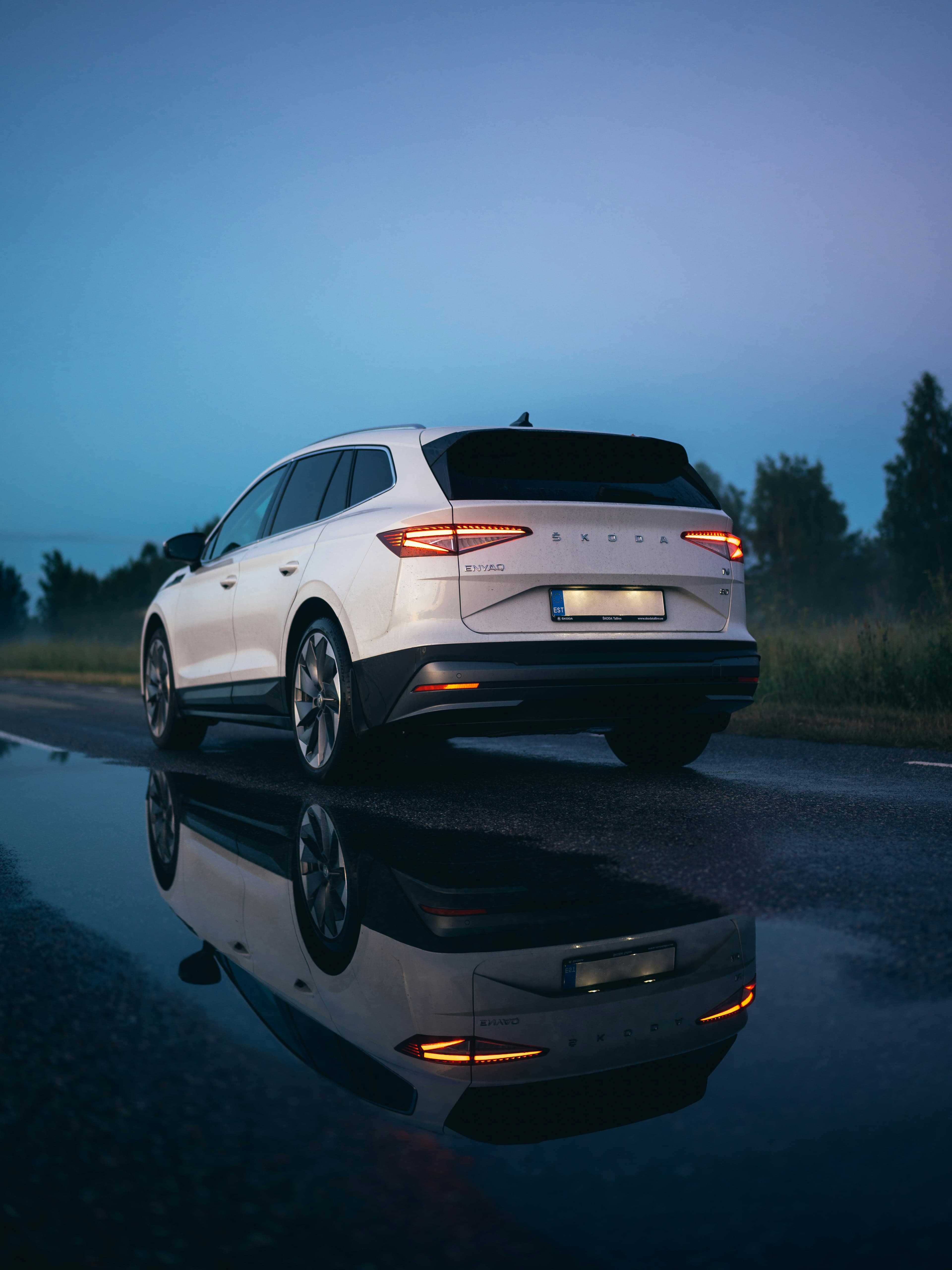
Škoda Enyaq is a fully electric family SUV from the Volkswagen Group and the first series-production Škoda built on the dedicated MEB electric platform. The car is offered with rear- or all-wheel drive, several high-voltage battery options, and as a conventional SUV or the more dynamic Enyaq Coupé.
The first Enyaq was introduced in 2020. Depending on the version, early cars had batteries of 55, 62 or 82 kWh and power from 109 to 225 kW.
For the 2024 model year, versions 80 and 80x were replaced by the more powerful and efficient Enyaq 85 and 85x, and in 2025 the model received a major update with the new Modern Solid design, revised aerodynamics and a range of more than 590 km for selected configurations.
At Volkkarihuolto Espoo you can book diagnostics and service for Škoda Enyaq at Ruukinmestarintie 7, 02330 Espoo.
Work directly on the high-voltage battery and other HV components is carried out only with the required qualifications and when the specific operation can be performed safely.
History of the Škoda Enyaq
The Enyaq was introduced on 1 September 2020 and became the first series-production Škoda on the Volkswagen Group’s modular MEB electric platform.
The high-voltage battery sits in the floor between the axles. This layout made it possible to leave behind the traditional front-wheel-drive Škoda architecture with a transversely mounted engine.
The Enyaq Coupé followed later. At launch the versions were:
- Enyaq 50
- Enyaq 60
- Enyaq 80
- Enyaq 80x
- Enyaq RS
Enyaq 50, 60 and 80
The early range had three battery sizes. The first three versions mainly used rear-wheel drive, while the 80x and RS gained a second electric motor on the front axle and all-wheel drive.
Original figures: Enyaq 50 — 55 kWh gross / 52 kWh net; Enyaq 60 — 62 / 58 kWh; Enyaq 80, 80x and RS — 82 / 77 kWh. Power was 109 kW for the Enyaq 50, 132 kW for the Enyaq 60, 150 kW for the Enyaq 80, 195 kW for the Enyaq 80x and 225 kW for the original RS.
So when diagnosing a used Enyaq it is important to identify not just the model name, but the exact version and model year.
Enyaq 85 and 85x
For the 2024 model year Škoda substantially updated the electric powertrain. Enyaq 80 versions were replaced by the Enyaq 85, and the 80x by the Enyaq 85x.
The Enyaq 85 got rear-wheel drive, 210 kW, an 82 kWh battery and improved efficiency. The Enyaq 85x also produced 210 kW, but used a second electric motor at the front and all-wheel drive.
At the same time Škoda improved battery thermal management and added battery pre-conditioning before rapid charging.
Updated Škoda Enyaq 2025
In early 2025 the Enyaq received a major facelift. The car moved to the Modern Solid design language and gained the distinctive Tech-Deck Face front end.
Production of the updated Enyaq and Enyaq Coupé started in February 2025 in Mladá Boleslav. By then Škoda had already delivered more than 250,000 Enyaq-family cars to customers.
The updated car was offered as Enyaq 60, Enyaq 85 and Enyaq 85x. Thanks to improved aerodynamics, the range of selected versions exceeded 590 km WLTP.
Current Enyaq model range
The model continues to evolve. Current specifications use Enyaq 60, Enyaq 85, Enyaq 85x, Enyaq RS and the matching Enyaq Coupé variants.
For newer model years two main battery capacities are quoted: 61 kWh gross / 58 kWh net for the Enyaq 60 in one later specification, and 82 / 77 kWh for the 85, 85x and RS.
Figures can change between model years, so service work must be based on the VIN of the specific car.
Škoda Enyaq high-voltage battery
The battery is one of the Enyaq’s main components. It sits under the floor and consists of individual modules and lithium-ion cells.
On the updated 2025 version the Enyaq 60 has a 63 kWh gross / 59 kWh net battery, while the Enyaq 85 and 85x use 82 / 77 kWh. When diagnosing the high-voltage system, checks may include:
- stored faults
- voltages of individual cell groups
- battery temperature
- balancing
- charging parameters
- cooling performance
- actually available energy
- computer diagnostics
Enyaq battery degradation
Any lithium-ion battery gradually loses part of its original capacity. A shorter displayed range does not automatically mean serious degradation.
The difference is especially noticeable in Finnish winters. For a real battery assessment you need diagnostic data, not only the kilometres shown on the display. Displayed range is strongly affected by:
- outside temperature
- heating
- speed
- wind
- wheel size
- tyre pressure
- snow
- driving style
- recent energy use
- computer diagnostics
How to check a Škoda Enyaq battery before buying?
The displayed range forecast depends on previous driving style and temperature, so it does not by itself show remaining battery capacity.
It is useful to check:
- HV system faults
- battery condition
- parameter spread between cell groups
- temperatures
- AC charging operation
- DC charging operation
- thermal management system
- warning history
- computer diagnostics
Škoda Enyaq AC charging
The Enyaq is designed for both home and public AC charging. Most modern versions use three-phase charging up to 11 kW.
If the car charges much more slowly than expected, the fault is not necessarily in the vehicle. It is useful to test the car on another working charge point. Points to check include:
- the charge station
- the cable
- available mains power
- number of active phases
- the car’s charge module
- stored faults
- computer diagnostics
- electrical system repair
Enyaq DC charging
Maximum rapid-charging power depends heavily on the exact version and model year. For example, on the updated Enyaq 2025: Enyaq 60 — up to 165 kW, Enyaq 85 — up to 135 kW, Enyaq 85x — up to 175 kW.
Charging from about 10 to 80% takes around 24–28 minutes in suitable conditions. Other model years differ. You cannot expect the same charging curve from an early Enyaq 60 and a new Enyaq 85x.
Why does the Enyaq charge slowly?
Low DC charging power does not necessarily mean a fault. At a high state of charge, power naturally falls. A cold battery also cannot accept maximum power straight away.
Charging power is affected by:
- battery temperature
- state of charge
- outside temperature
- station capability
- station-side limits
- battery condition
- thermal management
- computer diagnostics
Battery pre-conditioning
From the 2024 model-year updates the Enyaq gained battery pre-conditioning before DC charging. It can start automatically when a route is set to a compatible charge station, or manually via the infotainment system.
This matters especially in Finland, because a cold battery in winter can significantly limit rapid-charging speed. If charging remains unusually slow even after a long drive and pre-conditioning, the system should be checked.
Škoda Enyaq will not charge
If charging does not start at all, the high-voltage battery is not necessarily the cause. It is useful to check AC and DC separately. For example, if DC works but AC does not, the range of likely causes narrows clearly.
Checks include:
- the charge station
- the cable
- the connector
- charge connector locking
- the 12V battery
- the onboard charger
- the HV system
- communication between car and station
- computer diagnostics
- electrical system repair
Enyaq charge port
Do not try to force out a locked plug with heavy force. Causes can include the locking mechanism, a microswitch, an actuator, wiring or electronic control.
Possible fault signs include:
- the car does not detect the cable
- the connector will not lock
- the cable cannot be released
- charging stops at random
- the port flap works incorrectly
- electrical system repair
Škoda Enyaq 12-volt battery
Despite the large HV battery, the Enyaq also uses a conventional 12V system. It is needed for control units, locks, lighting, multimedia and starting the high-voltage system.
A weak 12V battery can cause an impressive number of faults. With many unrelated electronic errors, checking 12V supply is one of the first sensible steps. Possible symptoms:
- the car will not go into Ready
- many warnings appear
- central locking does not work
- multimedia reboots
- the HV system does not activate
- electrical system repair
- computer diagnostics
Enyaq rear-wheel drive
Most single-motor Enyaq versions use rear-wheel drive. The electric motor sits on the rear axle. For example, current Enyaq 60 and Enyaq 85 models use one permanent-magnet synchronous motor at the rear.
This differs from most traditional front-wheel-drive Škoda models. There is no conventional DSG, clutch, propshaft from a front engine, or traditional combustion engine.
Enyaq 85x all-wheel drive
The Enyaq 85x uses two electric motors. The main synchronous motor is on the rear axle, with an additional asynchronous motor at the front. The front motor engages electronically as needed.
This combines high efficiency, good winter traction and all-wheel drive. Such a 4×4 system is technically completely different from Haldex on a Karoq or Kodiaq.
Does the Škoda Enyaq have Haldex?
No. The Enyaq 85x and RS have no mechanical Haldex-type rear-axle coupling. Front and rear wheels are driven by separate electric motors.
So there is no typical Haldex oil, Haldex pump or classic rear-axle coupling found on traditional 4×4 systems.
Škoda Enyaq electric motor
An electric motor needs less routine maintenance than a combustion engine. There is no ICE engine oil, spark plugs, fuel injectors, turbocharger, EGR, DPF or timing belt/chain.
The electric drive still includes bearings, a reduction gear, seals, power electronics and cooling. Unusual humming, vibration or a drivetrain fault needs diagnostics.
Electric drive reduction gear
The Enyaq uses a single-speed reduction gear. Rear-wheel-drive versions have one unit; all-wheel-drive versions have separate front and rear drives. Similar humming can also come from wheel bearings or tyres.
Possible problem signs include:
- humming
- mechanical noise
- vibration
- fluid leak
- computer diagnostics
Škoda Enyaq thermal management
The high-voltage battery needs to operate in an optimal temperature range. Temperature affects available power, charging speed, recuperation, battery life and energy use.
Newer versions gained improved battery temperature control, and for the 2024 model year Škoda specifically upgraded thermal management and pre-conditioning before charging.
Enyaq cooling system
In an electric car, cooling serves several systems. If coolant level falls, the leak source must be found. Topping up regularly without finding the cause does not fix the problem.
Items that may need monitoring include:
- battery
- electric motor
- power electronics
- charger
- coolant leak diagnosis
- computer diagnostics
Škoda Enyaq heating
In winter, heating has a major effect on range. Unusually high winter consumption does not always mean a battery problem.
If the cabin heats poorly, heating cuts out intermittently, windows demist badly or energy use has become unusually high, the climate and thermal system should be checked.
Heat pump
On some Enyaq cars a heat pump is fitted depending on model year, market and equipment. Its job is to use energy more efficiently for cabin heating.
If the climate system behaves incorrectly, diagnostics must reflect the car’s actual equipment rather than assuming every Enyaq has a heat pump.
Winter use of the Enyaq in Finland
In winter an electric car naturally uses more energy. That is normal. Causes include a cold battery, cabin heating, winter-tyre rolling resistance, snow, dense cold air and short trips.
It helps to use cabin pre-heating while plugged in, battery pre-conditioning before DC charging on supported versions, and correct tyre pressures. If consumption remains clearly unusual even after warm-up, diagnostics can help.
Škoda Enyaq recuperation
During deceleration the electric motor can act as a generator and return energy to the battery. If the battery is cold or nearly full, recuperation may be limited temporarily. That is not necessarily a fault.
Recuperation intensity depends on drive mode, state of charge, battery temperature and, on relevant versions, navigation and road conditions.
Enyaq braking system
An EV uses recuperation actively, so the conventional brakes may be used less often. This matters especially in Finland.
Infrequent mechanical braking combined with road salt can lead to disc corrosion, seized mechanisms and uneven wear. So Enyaq brakes still need regular inspection.
Why can there be drum brakes at the rear?
On newer Enyaq models the rear axle uses drum brakes. This is a deliberate EV engineering choice: recuperation handles most everyday slowing, and a closed drum mechanism is better protected from corrosion and dirt.
Škoda specifies disc brakes at the front and drums at the rear for the updated Enyaq. Rear drums on an electric SUV therefore do not mean a “cheap” or inadequate braking system.
Front brakes
The front axle uses ventilated disc brakes. On the updated Enyaq 60 single-piston front calipers are used, while the Enyaq 85 and 85x use twin-piston calipers.
Inspection should cover disc thickness, corrosion, pads and free movement of the mechanisms.
Škoda Enyaq suspension
The Enyaq is a heavy car because of the large traction battery. Suspension and tyres therefore work under high load. The updated model uses MacPherson struts at the front and a multi-link rear axle.
Over time, attention may be needed for control arms, bushes, anti-roll bar links, ball joints, dampers and wheel bearings.
Škoda Enyaq DCC
Adaptive DCC suspension is available for the Enyaq. It changes damper behaviour with drive mode and road conditions. The updated Enyaq offers Normal, Comfort, Sport and Individual. Individual allows finer damper tuning.
If a fault appears, check the dampers, sensors, wiring and control unit.
Wheel bearings
The Enyaq’s high mass places a clear load on the hubs. A worn bearing can cause humming that rises with speed.
Similar noise can also come from winter tyres, uneven tyre wear or the electric-drive reduction gear. Localise the source before replacing parts.
Škoda Enyaq tyres
An EV has high mass, strong torque from standstill and, on many trims, large wheels. That can accelerate tyre wear. On all-wheel-drive 85x and RS models it is best to use four matching tyres of the same size and similar condition.
Pressure, geometry, tread depth and wear pattern should be checked regularly.
Wheel alignment
If tyres wear on one side or the car starts to pull, geometry should be checked. Alignment will not fix mechanical suspension wear.
Before adjustment, confirm there is no play, damaged arms, worn bushes or hub issues.
Steering
The Enyaq uses electromechanical steering. After suspension or steering repairs, geometry and related electronic settings must be considered.
Diagnostics are needed for power-steering faults, heavy steering, play, unusual noise or an off-centre steering wheel.
Enyaq RS
RS is the most powerful version in the family. For the 2024 model year the Enyaq RS gained 250 kW, two electric motors and all-wheel drive. DC charging reached 175 kW.
On newer model years charging and component figures can change, so the exact specification is taken from the VIN. On an RS it is especially worth watching tyres, brakes, suspension, battery condition, the electric drivetrain and the cooling system.
Enyaq Coupé
The Enyaq Coupé uses the same core electric architecture as the conventional SUV. Differences are mainly body shape, aerodynamics, equipment and selected powertrain options.
Technically, battery, charging and electric-drive diagnostics follow the same main principles.
Enyaq Sportline
Sportline is a sportier-styled version, but it is not the same as RS. Depending on model year it may have sport styling, a revised chassis, larger wheels and different equipment.
For service work, base decisions on the actual powertrain — for example 60, 85 or 85x.
Škoda Enyaq electronics
The Enyaq depends entirely on a complex electronic architecture. The car contains many control units for the HV battery, charging, electric drive, climate, assistants, multimedia and energy management.
One supply or communication issue can trigger several warnings at once. Replacing components without a full fault scan is rarely a good first step.
Enyaq multimedia
On early cars some owners may see software issues: freezes, reboots, a slow interface, phone-connection problems and unavailable app functions.
The cause can be software, supply or a specific control unit. Before replacing hardware, check software versions, faults and the 12V system.
OTA and software updates
Some Enyaq functions can depend on the software version. Updates may change infotainment behaviour, charging functions, thermal management, the interface and individual assistants.
With unusual behaviour it is therefore useful to consider not only mechanical condition, but also the software version.
Cameras, radars and assistants
The Enyaq can be equipped with Adaptive Cruise Control, Front Assist, Lane Assist, Travel Assist, Side Assist, cameras and parking systems. In winter, snow and ice can temporarily block sensors.
After windscreen replacement, body repair, suspension repair or geometry adjustment after damage, the relevant systems may need calibration.
Matrix LED
The Enyaq can be fitted with complex adaptive lighting. Because modern headlights are expensive, diagnostics should come first.
If a headlight fault appears, the cause may be the control unit, wiring, supply, ride-height sensor or the headlight itself.
Powered tailgate
Many Enyaq cars have an electric tailgate. If it will not open, stops, reverses or fails to close fully, check the actuators, latch, sensors, wiring and 12V supply.
Enyaq Coupé panoramic roof
The Enyaq Coupé is characterised by a large glass roof. Water is dangerous for electrical connectors and electronic modules.
If water or high humidity appears in the cabin, check seals, drains, previous body-repair work and body-panel joints.
Underbody and battery protection
The high-voltage battery sits in the floor. After a hard underbody impact the lower part of the car should be inspected — for example after a high kerb, stone, road obstacle or accident.
Damage to the HV battery housing needs professional assessment. Checks cover protective panels, the battery case, deformation, mountings and signs of leaks or mechanical damage.
Škoda Enyaq after an accident
After a serious collision it is not enough to check only the body. When buying a repaired car it is especially important to understand the nature of the previous damage.
You must consider the high-voltage battery, HV cables, pyrotechnic disconnection, charging system, electric motors and cooling system.
Trailer towing
Towing ability and permitted trailer mass depend on the exact version. On newer cars, all-wheel-drive variants have higher permitted figures.
For example, in later specifications the Enyaq 85x can tow a heavier trailer than a base Enyaq 60. Always follow the registration data for the specific car.
Pre-purchase Škoda Enyaq inspection
Diagnosing a used EV differs from checking a TSI or TDI. There is no need to inspect DPF, EGR, turbo, DSG, spark plugs, timing chain or timing belt.
Instead, special attention should go to:
- the high-voltage battery
- HV system faults
- AC charging
- DC charging
- the 12V battery
- the electric motor
- the reduction gear
- the cooling system
- climate
- suspension
- brakes
- tyres
- multimedia
- assistants
- underbody and battery protection
- computer diagnostics
What to check on a test drive?
After the drive it is best to run computer diagnostics on all control units. During the drive, watch for:
- smooth power delivery
- absence of humming
- absence of vibration
- recuperation behaviour
- steering
- unusual suspension noises
- heating performance
- dashboard faults
- computer diagnostics
Which Škoda Enyaq services we provide
At Volkkarihuolto Espoo you can book:
Work directly on the high-voltage battery and HV components is carried out only with the required qualifications and when the specific operation can be performed safely.
- Škoda Enyaq computer diagnostics
- electric drivetrain fault diagnostics
- 12V battery check
- AC charging diagnostics
- DC charging diagnostics
- charge port check
- electric all-wheel-drive diagnostics
- electric motor and reduction-gear diagnostics
- cooling system check
- climate system diagnostics
- brake repair
- suspension diagnostics
- DCC check
- steering diagnostics
- wheel bearing replacement
- tyre and alignment check
- multimedia diagnostics
- camera and electronic assistant check
- underbody inspection
- preparation for inspection
- pre-purchase Škoda Enyaq inspection
Common Škoda Enyaq fault signs
Book diagnostics if:
- the car will not go into Ready
- an electric drivetrain fault appears
- a high-voltage system fault appears
- the Enyaq will not charge
- AC charging does not work
- DC charging does not work
- charging interrupts regularly
- DC charging speed remains unusually low
- electric-drivetrain humming appears
- vibration appears
- energy use has risen sharply
- the cabin heats poorly
- coolant level is falling
- the suspension knocks
- DCC shows a fault
- brakes work unevenly
- many electronic warnings appear at once
- multimedia keeps rebooting
Škoda Enyaq diagnostics and service in Espoo
Need diagnostics or service for a Škoda Enyaq? Contact Volkkarihuolto Espoo at Ruukinmestarintie 7, 02330 Espoo.
The approach to an electric Škoda differs from servicing an Octavia, Superb or Kodiaq with TSI/TDI. There is no combustion-engine oil, DSG, turbo, DPF, EGR or timing belt. Instead the focus is on the high-voltage system, AC/DC charging, 12V supply, electric drivetrain, cooling, brakes, suspension and electronics.
Model year matters especially. An early Enyaq 60, Enyaq 80, updated Enyaq 85, all-wheel-drive 85x and Enyaq RS have different batteries, power, charging figures and software.
Correct diagnostics help identify the real cause and avoid unnecessary replacement of expensive high-voltage or electronic components.
FAQ
When did the Škoda Enyaq appear?
Škoda introduced the Enyaq iV on 1 September 2020. It is the first series-production Škoda on the Volkswagen Group’s dedicated MEB electric platform.
Which batteries were fitted to the early Enyaq?
The original range used batteries of 55, 62 and 82 kWh gross capacity depending on version.
What happened to the Enyaq 80?
For the 2024 model year the Enyaq 80 was replaced by the more powerful Enyaq 85, and the 80x by the new 85x. Power increased, and battery control and thermal management were improved.
What battery does the Enyaq 85 have?
The current Enyaq 85 uses a battery with 82 kWh gross capacity and about 77 kWh usable capacity.
Is there an all-wheel-drive Škoda Enyaq?
Yes. The Enyaq 85x and RS use two electric motors and all-wheel drive.
How does 4×4 work on the Enyaq?
The main synchronous electric motor works on the rear axle, and on the 85x an additional asynchronous motor is fitted at the front. This is electric all-wheel drive, not Haldex.
Does the Enyaq need Haldex oil changes?
No. There is no Haldex on the Enyaq. All-wheel-drive versions use separate electric motors on the front and rear axles.
Does the Enyaq have a DSG?
No. The electric motors work through single-speed reduction gears. There is no classic dual-clutch DSG.
How fast does the Škoda Enyaq charge?
It depends on version and model year. For the updated Enyaq 2025, up to 165 kW is quoted for the Enyaq 60, 135 kW for the 85 and 175 kW for the 85x.
Why does the Enyaq charge slowly in winter?
A cold battery limits charging power to protect the cells. Newer versions use battery pre-conditioning before DC charging.
Why does the Enyaq cover less distance in winter?
Low temperature increases energy use for heating and thermal control and also raises driving resistance. A winter drop in real-world range is normal for an EV.
Does the Enyaq have a 12V battery?
Yes. It powers the low-voltage electronics and activates the high-voltage system.
Why does the Enyaq have rear drum brakes?
An EV handles most everyday slowing with recuperation. The closed rear drum design is well protected from dirt and corrosion. On the updated Enyaq Škoda uses discs at the front and drums at the rear.
Is there an Enyaq RS?
Yes. The RS uses two electric motors and all-wheel drive. For the 2024 model year power was raised to 250 kW.
Can a Škoda Enyaq be checked before purchase?
Yes. It is especially useful to check the HV battery, high-voltage system faults, AC/DC charging, the 12V battery, the electric drivetrain, the cooling system, suspension, brakes and the underbody.
Detailed Services
Professional fault diagnostics for Skoda Enyaq.
Oil ChangeEngine oil and filter replacement for Skoda Enyaq.
Annual maintenanceComprehensive annual maintenance for Skoda Enyaq.
Regular MaintenanceScheduled maintenance for Skoda Enyaq according to service needs.
Engine RepairEngine diagnostics and repair for Skoda Enyaq.
Diesel Engine RepairDiesel engine service and repair for Skoda Enyaq.
Electrical RepairElectrical fault tracing and repair for Skoda Enyaq.
ECU ProgrammingControl unit programming and coding for Skoda Enyaq.
DSG RepairDSG transmission diagnostics and repair for Skoda Enyaq.
Transmission RepairTransmission diagnostics and repair for Skoda Enyaq.
Transmission Oil ChangeTransmission oil change for Skoda Enyaq.
Timing Belt ReplacementTiming belt and related component replacement for Skoda Enyaq.
Timing Chain ReplacementTiming chain, tensioner, and guide replacement for Skoda Enyaq.
Cooling System RepairCooling system service and repair for Skoda Enyaq.
AC RepairAir conditioning service and repair for Skoda Enyaq.
Engine Heater InstallationEngine heater installation and service for Skoda Enyaq.
Cabin OzonationCabin ozonation and odor removal for Skoda Enyaq.